of the burglaries the FBI counted in 2025 were entries without force.1 No kicked door, no broken glass.
And the most expensive surprises come later, when the policy you paid for years doesn't cover what happened. The Claim-Proof Home is three plain books about both: the cheap fixes, the scams aimed at retirees, and what your homeowners policy won't pay.
Get all three booksInstant PDF download · Large type · Print as many as you need30-day money-back guarantee. Or start with the free night checklist.
The FBI collects burglary reports from police and sheriff's departments in every state. Pick yours to see the 2025 rate next to the country's.
Source: FBI Crime Data Explorer, burglary offenses reported by law enforcement agencies, January to December 2025, data refreshed October 15, 2026. Rate = burglaries reported per 100,000 residents of the areas whose agencies reported.2 A low rate is good news, not a guarantee: every one of these numbers is somebody's house.
The average amount insurers paid per homeowners theft claim, 2019 to 2023. That's what got paid, on top of what the family covered with the deductible.3
Roughly what the weekend plan in Volume One costs at a hardware store: long screws for every door, lamp timers, sticks for the sliders, window pins. Our estimate at 2026 prices.
A typical cap on cash under a homeowners policy, in New York's regulator's list of examples. Yours may differ. Volume Three shows you where to look.4
The point isn't to scare you. Burglary has been falling: the FBI's 2025 rate was the lowest in twenty years.1 The point is that the cheapest protection is a habit and a few screws, and the most expensive mistake is finding out what your policy says after the fact.
Twenty fixes for $0 to $50, each with what it costs, why it works and the mistake that ruins it.
People 60 and over reported $7.7 billion in losses to the FBI's Internet Crime Complaint Center in 2025.5 This volume is your script.
How homeowners policies generally work, written by a character who spent his life on the claims side. General education, not advice on your policy: it ends with the twelve questions to take to your agent.
Secure checkout by Gumroad. 30-day money-back guarantee.
Two printable add-ons you can add at checkout:

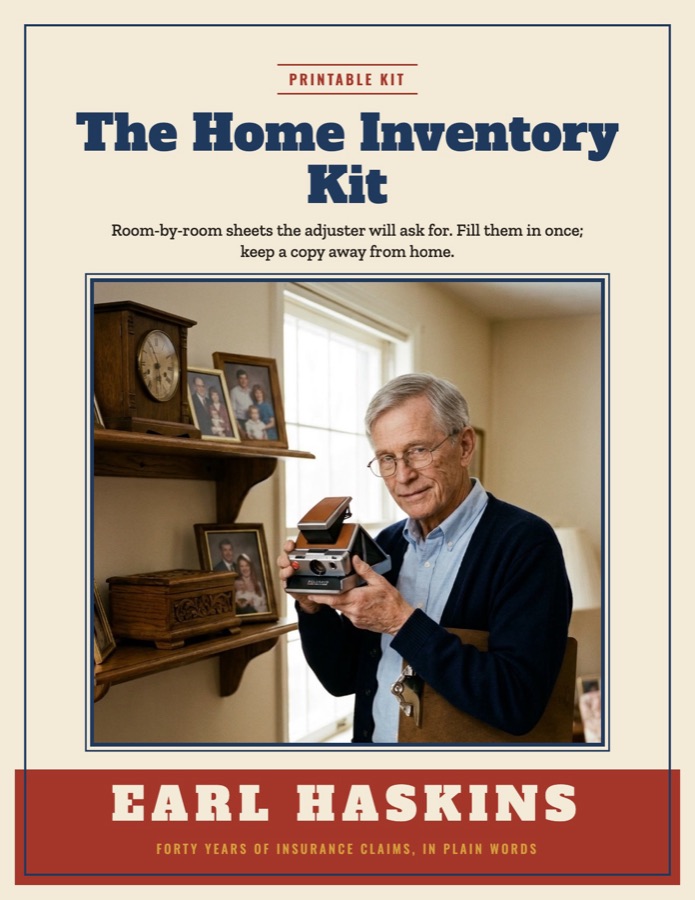
A sheet for every room, the policy snapshot, serial numbers, a claim log and a receipts page. The list the adjuster asks for, made ahead of time.

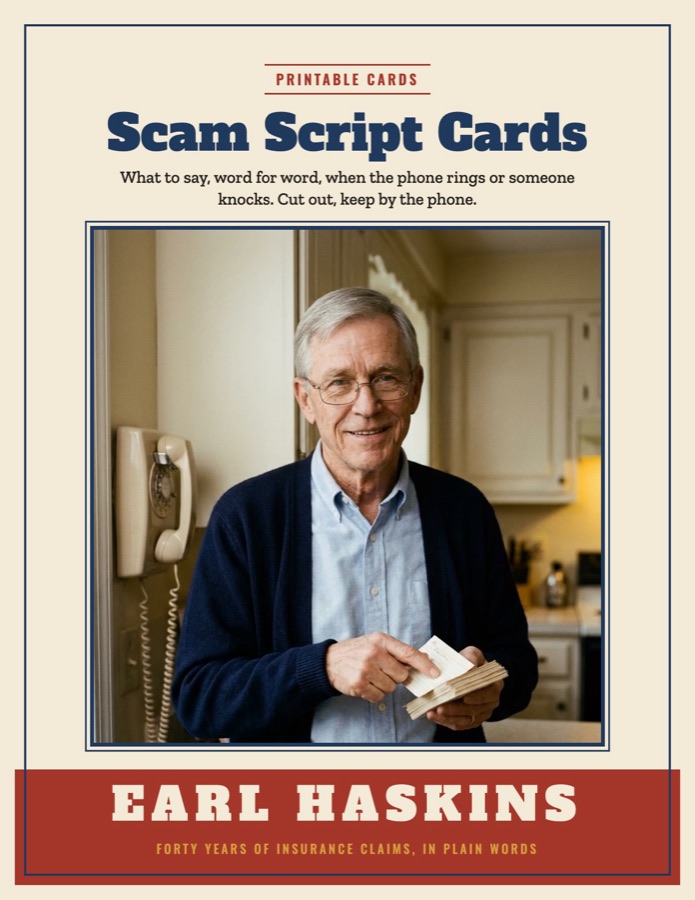
Eight cut-out cards to keep by the phone and the front door: the signs, the exact words to say, and what to do after.
Read the books, do the fixes, call your agent. If within 30 days you feel it wasn't worth it, reply to your Gumroad receipt and you'll get a full refund. No questions, and you keep what you printed.
Earl is a retired insurance claims adjuster from the Midwest: forty years of walking through homes after the bad night, and learning what went wrong. He is a fictional character, voiced and illustrated with AI, created to explain home safety, scams and insurance in plain words.
Because Earl is invented, nothing in his books rests on his word. Every number and every rule comes from a public source: the FBI, the FTC, the U.S. Postal Inspection Service, the NAIC, the Insurance Information Institute, Social Security, Medicare and others, all listed at the back of each book. When the books describe a situation, it's an illustration, and they say so. There are no made-up testimonials on this page, and there never will be.
Ten things to check before bed, on two printable pages. Tape it inside the front door. Pay what you want, starting at $0.
Get the free checklistNo. Earl is a fictional character, voiced and illustrated with AI. The facts in the books are real and sourced; Earl is the voice that explains them.
From public sources you can check: the FBI's Uniform Crime Reporting Program and Internet Crime Complaint Center, the Federal Trade Commission, the Bureau of Justice Statistics, the U.S. Postal Inspection Service, the NAIC, the Insurance Information Institute, Social Security, the IRS, Medicare and others. Each book lists its sources at the back, with links. The 2012 survey of burglars from UNC Charlotte is included with a note that the alarm industry's research foundation paid for it.
No. It explains how homeowners policies generally work and what questions to ask. Every company and state is different, so the books keep sending you to your agent and your state insurance department.
Three PDF books in large type, made for US Letter paper. You can read them on a phone, tablet or computer, or print them at home. The download link arrives by email right after checkout.
No contractor. Most fixes in Volume One need a screwdriver; a few need a drill. The rest are habits that cost nothing.
Volumes One and Two, yes. Ask your landlord or association before changing locks or doors. Renters and condo policies work differently from homeowners policies, so use Volume Three as a list of questions for your agent.
Ask for a refund within 30 days by replying to your Gumroad receipt. You'll get your money back.
Yes. On Gumroad you can type $0. If you'd like to pay something, that's up to you.
That's most of it. The books cover the rest.
Get The Claim-Proof Home · $47